Monday, May 30, 2016

Are Miracles Possible?

Definitions are important.  David Hume defined that a "miracle" is that which is in opposition to the natural laws of the universe.  He defined the "universe" to be all that is, and that the laws are how they ran.  A miracle, by that definition, would be in opposition to reality.  Therefore nothing.

But a standard definition of "miracle" wouldn't be understood that way.  A "miracle" might be understood to be the action of a power of reality ( a subgroup of all that exists) that is beyond the perception of humanity to explain.  Then a miracle would just mean that the universe contains more than humanity can see.

Science has no problem with this.  They admit that gravity exists, but they do not know how or even how it works or where this force comes from. No one would call gravity a "miracle", because it follows certain predictable laws, but perhaps the origin of gravity is.  It is certainly beyond human comprehension.

A chronically ill person is sick, they are prayed for and then they are healed.  Is that not a miracle, whether you believe in God or not?  We experience hope with no reason to found it on and our hope is realized.  Is that not a miracle?  Science claims humanity will cease by a certain date, but humanity continues.  Is that a miracle, or simply progress?

The problem of a miracle is when we take a event or experience that is beyond human explanation or knowledge and determine absolutely what the source of that miracle is.  A miracle is, by its very nature, mysterious.  To claim that a source of a miracle is a powerful being or to claim it is a psychological phenomena are both equally premature.

Perhaps we need to embrace the mysterious nature of the universe?  Recognizing that we simply will not know all there is to be known?  Can we ever understand all causes of all things?

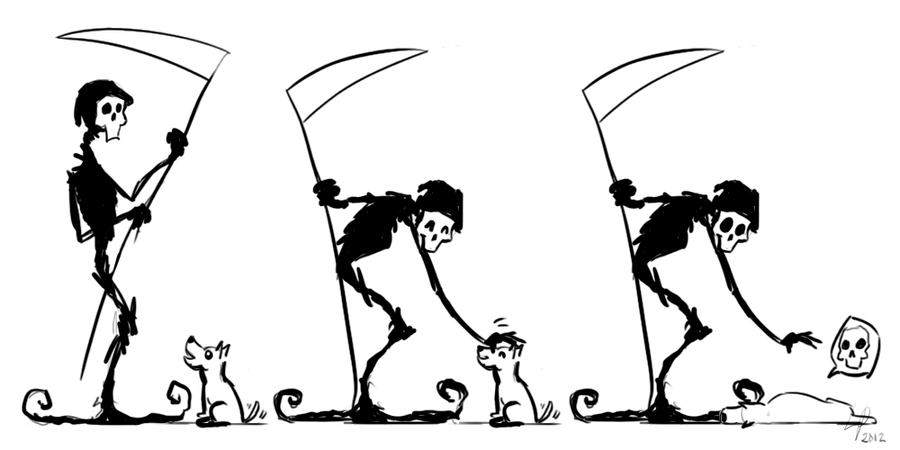
What is the Significance of Death?

For some, the cessation of life is a bad thing.  It means no more energy, no more activity, no more pursuing, no more forcing of one's will, no more hoping, no more joy.  For others, death is a positive thing.  It means rest, it means peace, it is the end of oppression, then end of suffering.  Death might look horrible on the surface, but that is our experience of deaths of those whom we love.

Every person is connected to another, and each person we know makes up part of who we are (through mirror neurons).  So when we experience their death, we experience a loss of a part ourselves.  Does this mean that our experience of death must also be dreadful?  Might the different perspective equate a different experience? Might death be positive.

Is it possible that the cessation of our life could be positive?  After all, the end of our existence means the end of our universe.  We have only one perspective to understand the world from, and our whole universe takes place in our brains.  Without our brains, all of reality, all of the universe ceases to exist from our perspective.  How can this be good?  All that we have done fades and all that we have accomplished is for naught.

On the other hand, from our perspective, all of our striving and trials and difficulties are faded as well.  There is no longer any evil.  And since our brain is no longer functioning, we cannot experience any angst about our cessation.  Non-existence means no emotional insecurities.

But does death automatically mean the end of our existence?  Plato held that our bodies, including our brains, are just holding us back from true freedom.  Since we have lived, can we cease from living?  Is there not some way in which existence might always be, but without the constraints and shackles of the body?

And even if our life and existence is trapped to the body, is it not possible that a future entity, a future humanity, might take our DNA and re-create us, giving us a new chance at life?  Is our life really over?  Can it ever really be over?


Friday, October 3, 2014

Demons: A Philosophic Introduction

Historically, demons played a significant place in history.  Millions have died because of the assumption of demonic influence, by monotheists and polytheists and spiritualists.  Some see demons behind every corner, even today.  Demons are the epitome of evil, the enemy of humankind and of all that is good.  From a philosophic standpoint, how do we consider the demonic, or that which is called demonic?

Many call demons just a myth, just stories to entertain and to encourage certain moral practices.  Certainly the tales of Faust and Hellboy are but stories. But how does one explain the many, many experiences of evil spirits that people claim are true?  The story of The Exorcist by William Peter Blatty is supposed to be based on true events, and other exorcisms are confirmed.  What do these real events mean?  Are they all mechanisms of the insane? 

Eugene Thacker, in his philosophic work, In the Dust of this Planet, suggests that the demonic is a method by which we culturally explore the reality of nothingness. The absence of life, of meaning, of purpose frightens us so that we personify it and label it as a being itself.  This would make sense with demons being our own temptations, and evil circumstances.  But what about the stories of spirits who attack?  Of those who are innocent, but experiencing judgment?  Are demons just a way to speak of evil coincidence? Of statistical probability that bad circumstances will happen to us?

It is also true that in ages past many items that we have labels and some understanding of were called demonic in the ancient and medieval world. Schizophrenia, seizures, fits of rage and fevers were often “caused” by evil spirits in the ancient world.  So is that which we do not really understand (like schizophrenia, which we can describe and label, but not really determine the cause), or cure still a black box, even though we do not call it “demonic”?  Are we really any better off than those who called it demonic?  Is a book collecting a list and descriptions of mental disorders really any better than a witch hunter’s manual which catalogs and describes demonic activity? What is really the difference?


Associated with mental disorders are those who cannot fit into society or belong to a different culture. In the past, some were called demonic, even though they had a place in their original society, such as spiritualist healers and astrologers.  The foreign or strange is often called demonic by those who do not understand certain actions.  Is the demonic fundamentally a way of us describing our own discomfort of those who act in a socially awkward or unacceptable manner?  Are those who cannot understand or appreciate societal nuances still make outcast in the same way, even if we do not use the term “demonic”?  Are the labels that separate the unwanted any better or worse than the term “demonic”?

Sunday, June 29, 2014

Solitude v. Community

Some consider the path of Solitude the best path of living.

Solitude allows the contemplation of a deeper reality, which the distractions of everyday busy life do not allow.
Solitude allows there to be personal authenticity, so we can know who we are and not just who we seem to be before others.
Solitude develops self-discipline and self-reliance, which leads to self-empowerment.
And, it is said, solitude alone can give us the peace of mind and reflection to consider how best to act and live.

Others consider Solitude to be a danger.

Alone, a person has no real purpose or focus, but instead only falls deeper into the self which is an empty hole.
Solitude leads to madness, fear of others, paranoia and self-delusion.
In fact, they say, the right way to live can only be discovered with others.  Without others, we cannot love, we cannot be faced with uncomfortable truths, and we cannot build on other's strengths.
If we are to be our real selves, we discover that self by connecting in community.  Without community, we are only a shadow of our deepest selves.

Some say that our lives and communities should be a balance between solitude and community.

Too much solitude or too much community is dangerous.  In solitude, we cannot empathize.  In community, we can become numb from overwhelming empathy.
Some gain much from solitude, while others gain nothing from constant relation in community.  Different people are different.  To say that only one is beneficial is like saying that it is a moral requirement for everyone to be married or for everyone to be single.
There are different purposes for each activity.  Community teaches us love.  Solitude gives us the opportunity to consider pure truth.  In the balance of these two activities is the real truth.

What do you think?

Sunday, June 15, 2014

Impossible Questions

At a move theatre, which armrest is yours?

At what point does a day stop being partly sunny and become partly cloudy?

What would happen if Pinocchio said, "My nose will grow longer!"?

If vampires can't see their reflections, why is their hair always so neat?

What do you do when you see an endangered animal that is eating an endangered plant?

Is it rude for a deaf person to sign with food in their hands?

Can a short person talk down to a tall person?

What was Captain Hook’s name before the alligator bit off his hand?

Do graveyard caretakers get a cost of living increase?

Why are builders afraid to have a 13th floor but book publishers aren't afraid to have a Chapter 11?

If you ate pasta and antipasti, would you still be hungry?

Can an illiterate person really appreciate alphabet soup?

If there's an exception to every rule, is there an exception to that rule?

Why is it that when a person tells you there's over a million stars in the universe you believe them, but if someone tells you there's wet paint somewhere, you have to touch it to make sure?

Aren't all generalizations false?

How do you treat someone addicted to counselling and self-help groups?

If women ran the Pentagon, would missiles and submarines be shaped differently?

Why is abbreviation such a long word?

Why isn’t phonetic spelled like it sounds?

Shouldn’t monosyllabic be shorter?

Should burn victims get a discount at a crematorium?

If electricity comes from electrons, does morality come from morons?

How much deeper would the ocean be if it had no sponges?

If quizzes are quizzical, then what are tests?

When the police arrests a mime, do they tell him he has the right to remain silent?

If the world didn't suck, would we all fall off?

What does it make me when someone calls me gullible and I believe them?

If a deaf person is taken to court, is it still called a hearing?

How important does a person have to be when they are no longer "murdered" but "assassinated"?


What if the hokey-pokey really is what it's all about?

Sunday, January 26, 2014

Seeking God

Many of us desire to find God, and some spend their whole lives just doing this.  But why?  Is God so the center of the meaning of our lives that we should be seeking Him?  Is God the Source we should be seeking, or is there another Subject that is more true, more to the core of our being?  Some have said that we should not be seeking God, but ourselves, humanity, reality, love, economic stability, truth, power....  If we find God will we find all these as well?  If we find these will we find God?

Is God even an object to be discovered?  We can discover most things within our own universe, eventually, but if God is outside of our universe, then can we truly discover God?  Can we only describe God through what God is not, because we cannot see or measure what God is?  Is it possible to describe or communicate God at all, if God is beyond our imagination?

What would be the tools to discover God?  If God is beyond human comprehension, then perhaps God is the only one to describe what or who God is.  But what is this revelation in which God describes God?  Is it creation, made by God, but ravaged by time?  Is it physics, the building blocks of creation?  Is it the human mind, the most sublime creation?  Is it a text in which God laid out the most important thoughts about God?  Is it a person, who communicated God most sublimely through both words and action?

Who are we to make such choices?  Can we grab onto one of these tools and call it the ultimate revelation?  Or should we live our lives and hope that God is some rock that we will stumble upon and everything will make sense? Is such a search ultimately futile or fruitful?