Sunday, January 26, 2014

Seeking God

Many of us desire to find God, and some spend their whole lives just doing this.  But why?  Is God so the center of the meaning of our lives that we should be seeking Him?  Is God the Source we should be seeking, or is there another Subject that is more true, more to the core of our being?  Some have said that we should not be seeking God, but ourselves, humanity, reality, love, economic stability, truth, power....  If we find God will we find all these as well?  If we find these will we find God?

Is God even an object to be discovered?  We can discover most things within our own universe, eventually, but if God is outside of our universe, then can we truly discover God?  Can we only describe God through what God is not, because we cannot see or measure what God is?  Is it possible to describe or communicate God at all, if God is beyond our imagination?

What would be the tools to discover God?  If God is beyond human comprehension, then perhaps God is the only one to describe what or who God is.  But what is this revelation in which God describes God?  Is it creation, made by God, but ravaged by time?  Is it physics, the building blocks of creation?  Is it the human mind, the most sublime creation?  Is it a text in which God laid out the most important thoughts about God?  Is it a person, who communicated God most sublimely through both words and action?

Who are we to make such choices?  Can we grab onto one of these tools and call it the ultimate revelation?  Or should we live our lives and hope that God is some rock that we will stumble upon and everything will make sense? Is such a search ultimately futile or fruitful?

Sunday, December 29, 2013

What is Your Relationship to Truth?

Stephen Crane writes:

"Truth," said a traveller,
"is a rock, a mighty fortress;
Often have I been to see it,
Even to its highest tower, 
From whence the world looks black."

"Truth," said a traveller,

"Is a breath, a wind,
A shadow, a phantom;
Long have I pursued it,
But never have I touched
The hem of it's garment"

Are you more like the first or the second traveller? Or is your relationship to truth different than either? What is your experience?


Perhaps truth is more of an archipelago, where you travel to one island, only to find a larger island behind it?


Perhaps truth is a library, where there are so many opinions and detail that cannot be measured, but there is no determining factor between them?  Even the distinction between "fiction" and "non-fiction" get us no closer to truth.


Perhaps truth is a dense, rich book, written in another language, which we cannot understand, nor learn?


Perhaps truth is a pool, in which one swims daily and is refreshed?


Perhaps truth is a dream in which one sleeps and rests, but when awakened both the substance and the content of the dream can no longer be grasped?


What do you think?


Thursday, December 26, 2013

The Nature of Natural Love

Love truly is a many splendored thing.

So many-splendored that we can't even decide what it is.  Is it romance, is it desire, is it benevolence, is it self-surrender?  Is love a singular idea, or a complex of ideas that we give one overly-simplistic name? We have covered some of this ground in the topic "What is love?" but there is still much controversy to discuss.

Love is the connection between ourselves and the other.  Can that connection be anything apart from self-interest?  Is there truly love in altruism?  Is our deep and abiding care in another really be about them, or is it all about ourselves?  Is love, in the end, simply meeting our own desire, or can it ever be purely about the other?  Even the hero who sacrifices her own being for the other, is it really about the other purely, or is it about the self's desire to perpetuate the other at all cost?  Is it about the self's reputation?  Or is there a chance, a moment in which the self is forgotten and the other is the pure focus?

If there is no such thing as pure altruism, then can we ever blame another for selfishness, for are not all acts, in the end, selfish?  If there is altruism, what is the mechanism that triggers it?  Or is altruism even good for our society, or does it create martyrs of us all, leaving no one to actually live?

Is love an emotion, which we cannot control?  Is love simply a spark, an overwhelming urge that we are led by?  Or is it an act of volition, a decision that we make?  Or are different kinds of love of different natures?  Perhaps we cannot decide who we fall in love with, but we can determine who we give affection to?  Or is love a habit, one that we decide at first and then it becomes so overwhelming that we can no longer control it?  Is love ultimately addictive?

We all must admit that some loves end.  The object of our enduring desire may become hatred over time.  But can that be changed?  Can we remain in love, if we so determine that?  Is hatred really the opposite of love, but both completely wild and undetermined?  Or do we season each?  The issue with love being permanent is that we change, become different people over time.  How can our loves be the same?   But perhaps love also seasons and refines over time.  Can we love the same person that we were married to some 25 years hence, but the nature of that love change that we would not recognize it for what it once was?   Or dare we not even call what our initial "love" turns into "love" at all?  Should we hold some affection for a person after so long is it truly love or simple nostalgia or simply habit?


Monday, November 25, 2013

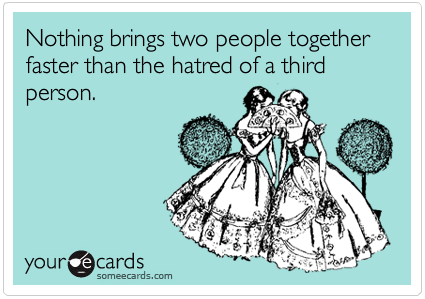
What is the Logic of Hatred?

Many psychological philosophers have spoken about the logic of emotions.  Anger is a response to injustice, fear a response to danger, lust a need to reproduce.  Hate is akin to anger, yet one can express hatred to a person one has never met or an idea not yet heard.

Operating on the assumption (which may not be reasonable) that there is a logic to hatred, what might that reasoning be?

Is hatred simple retribution?  A gang member is killed in a fight, so the grieving gang must get revenge on the gang who killed, which leads to revenge back.  This leads to a perpetual feud and mutual hatred between the groups. It is "eye for an eye" gone out of control.

Is hatred a result of misplaced personal identity?  Homophobia seems to be a form of this, where those who are most clearly homophobic are those most struggling with homosexual desires.  These desires do not fit the identity of the person having these desires, so he projects all his anger at himself on others who freely express those desires.

Could hatred be the result of fear?  The connection between fear and anger has long been noted, that one tends to be angry at what one is most afraid of.  This is especially true when one's security is threatened (or imagined to be threatened), and so one reacts with hatred to that which is assumed to cause insecurity or threatens.  Certainly Hitler feared the Jews and assumed that they had power to economically control Germany's destiny, which the Nazis feared, thus fueling their hatred.

Could hatred be a response to any stripping away of any human need?  When a person has what they consider to be a basic need taken from them, or they are denied the opportunity to meet their need, they respond with anger and violence.  Perhaps hatred of those previously unknown is the assumption that that person or group will take away from them what they need.  The KKK assumed that blacks were naturally violent and sexually deviant and so they had to protect themselves.  A black man values respect and he assumes that no white man will ever give him the respect he is due so he has a hatred of white men.  Cultural misunderstandings could perpetuate this.

Or is hatred simply without reason?  We draw up excuses for why we hate another but the actual reason for hatred is lacking, it being just an anger that cannot be controlled?

Sunday, February 10, 2013

What Makes Good or Bad Food?

Who is eating who?
Recently there has been a whole glut of books and articles about food and growing practices.  Organic is good and genetically modified food is bad.  The movie Food Inc., the author Michael Pollan and the book and movie Fast Food Nation has stirred the pot and caused us to question a lot about what we eat.  However, there seems to be a lot of finger pointing and not many questions about the nature of our food.

What is the purpose of food?  Is food only about eating and health?  Of course if there is a food that is actually a poison, that would be bad, like the wells in Bangladesh that was discovered to have a natural arsenic in them, and so was killing off many villagers, over a period of years.  But should we look at food as only "healthy and unhealthy"?  Even though we all recognize that a pack of M&Ms aren't necessarily healthy, a starving child in Darfur would be overjoyed to have such a pack and no one would refuse it to her.  Nor a genetically modified carrot.

Of course, food isn't only about health.  There are many cultural factors involved in food.  Most places in the world would find pickled caterpillars to be distasteful, but not in Congo (and they really are tasty... nutty).  When we look at food, we want to know it's source and who made it and what it is made of because if there is horse or Monsanto or bugs involved, we don't want to have anything to do with it.  But these are cultural factors.  What is the difference between horsemeat and beef?  What is the difference between Monsanto and your local farmer who might (or might not) beat his wife?  What is the difference between bug-filled food and the fact that we are actually filled with bugs ourselves?  The fact that our culture teaches us that one is acceptable and the other not, for many reasons.  Perhaps we need to distinguish issues of culture and acceptability within our society and actual health.  Just because a cake looks like a newborn baby doesn't mean it isn't tasty (nor does it mean that we should eat it).  If we are concerned about cultural issues, should we rise a cry of alarm, if the health risks are actually minimal?

Super Size Me star getting a checkup
Of course, science should determine what is healthy and not healthy.  But which science?  The science of thirty years ago that told me that eggs were bad for me or the science of twenty years ago that said that eggs were healthy?  The science of modern medicine that focuses on medicine or of naturopathic medicine that focuses on naturally grown medicines?  Western science or Chinese or Indian?  Each of these sciences can give very different options and, for the most part, their methods are a black box to almost all of us and we only know their conclusions.  We trust one and not another, often because we grew up with one and not another.  We might change our minds radically from what we grew up with, and we might not, but who is to say that one choice or another in listening to science makes us live better or not?  It is not given for us to know what would happen, only what did.

Who makes our decisions about our food?
In the end, the questions about food come down to epistemological ones-- how do we know that this information or that is true for me?  And even if it is true for me, how do I know it is true for someone else?  Do I have enough time to follow up every study ever written?  And should I bother about it when I am relatively healthy?  Are there conclusions that every form of science agrees with (like a high level of some cholesterol is bad), and should we look for consensus between different disciplines?  How much should we remember that everything we put into our bodies-- whether a carrot or an M&M-- creates a chemical change in us, and which chemical changes do we really want? How much of our food should be medicinal, and how much of it preventative and how much of it enjoyment?  And how much should we insist that our family and friends make the same choices as we about our food?

Wednesday, January 23, 2013

What is Friendship?

In ancient times, friendship was a major topic of philosophical speculation. Aristotle to Marcus Aurelius had deep concern about friendship and how this relationship effected one's life and ethical actions.  Today, friendship seems less of a focus, and more of an assumption.  Romance and sex take center stage, but friendship seems not so significant.

This seems even more so with the advent of Facebook and it's use of relational terms which seems to minimize one's relationship to the most shallow degree.  We are "friends" with people whom we barely know or don't know at all.  We "like" opinions and jokes that we might only have barely understood, let alone approved of.  We comment on each other's status' only barely brushing each others' souls. Is this what friendship constitutes?

Yet is the physical connection to our friends too emphasized?  Just because our friend is across the country from us, does that make us less of friends?  It might be that we have lost touch, but that is less true in our world of internet connection.  Often the internet allows us to connect to people more deeply than when we saw each other face to face.  But are we missing something?  We certainly do not hear the sarcasm in one's voice or the wink of the eye.  Internet connection is little more than glorified pen pals. Does physical presence truly add more to a friendship?  Also, if everyone we know is a "friend" does that minimize what friendship really is?

What is the essence of friendship?  We can have friendships based around one subject, even just a hobby.  We can have a friendship that develops through small talk about one's family.  We can have a friendship in which we discuss the deepest aspects of our emotions, but we never see each other's partners.  What is friendship based on?  A mutual subject of agreement?  Enjoyment of the other's company?  Common activities, whether it be horse racing or drinking coffee?

What is the "social contract" of friendship?  Each relationship has unspoken agreements.  For a marriage it is often sexual faithfulness and mutual financial support.  In the workplace an employer agrees to pay employee for the employee's service and obedience.  What about friendship?  Is there an agreement to agree?  An agreement to be open about certain topics?  A hidden agreement to support each other on certain subjects, even in opposition to each others' families?  An agreement to help each other out in dire times of need?  This "contract" is certainly different with different relationships, but how is such a contract determined, since we almost never discuss aloud how our relationship works, yet we have an agreement as to how it does?

What is the relationship to friendship and marriage or co-habitation?  Is a boy- or girl-friend just a "friend with benefits" or is there more to it than that?  Is an acquaintance just a friend-in-training, or is it a completely different relationship?  

Saturday, September 15, 2012

Is Life Worth Living?

The universe is big.  We are not.
Does our puny existence really make any difference?
Yes, we all have an instinct to survive, to thrive, but rarely do we look at the assumptions of this instinct.

Is it better for us to live as individuals?  Are we actually improving other's lives?  Are we causing life to continue or to recess?  Is our life good on its own, without reference to anyone else?  Are we living in joy or even contentment?

All of this causes us to look deeper.  What is the purpose of our lives?  Are we given that purpose by another, or do we create it ourselves?  Is our purpose innate, or is our purpose discovered over time?  Do we not discover our purpose until our life is finished and we can look back on the whole thing and discover the purpose?  Or is there no purpose whatsoever?  Is it that we just are, there is nothing else, no one else, we can really compare or contrast ourselves to because we are and there is nothing else to say about it?

And what about life and existence in general?  Are we a part of a bigger purpose, effort, or are we completely independent?  Does life, all matter in the universe have a purpose, or is it just existing and there is nothing else?  Is matter moving toward a conclusion or is it all waves, temporary patterns and return to the abyss from which matter came?

Or is there any abyss?  After all, if matter exists, did it not always exist?  And if there is existence, then does it not exist for a reason?  Even if that reason is simply to exist?  Is there not joy just in existing, even if the universe at large isn't interested?  Perhaps there is no abyss, but only being?

In the end, perhaps it is enough to know that we exist.  To end our existence is the greatest acts of pride, because that one act takes all the evidence of our existence, and calls them negligible, with less than no purpose. Because if we have no purpose, there is no reason to act.  If we act, we do so with the intent to improve.  Is not living the answer to worth?